Tritanomaly Test Score: Read the Study’s Three Bands
If your result is from the study’s 12-plate Tritan section, match the number correct to this table. It is a study-specific reference, not a universal tritanomaly scale.
| Correct | Label in this study |
|---|---|
| 6–9 of 12 | Mild |
| 3–5 of 12 | Moderate |
| 0–2 of 12 | Severe |
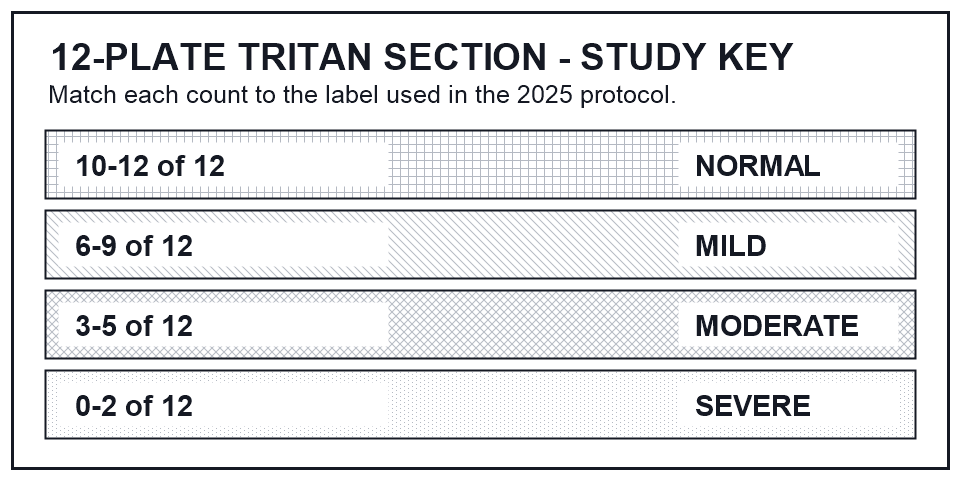
In the same 2025 protocol, 10–12 correct was labeled normal. If your report used another test or a different section, these bands do not tell you where that score falls. Read the source protocol and scoring table.
What this mild tritanomaly score table applies to
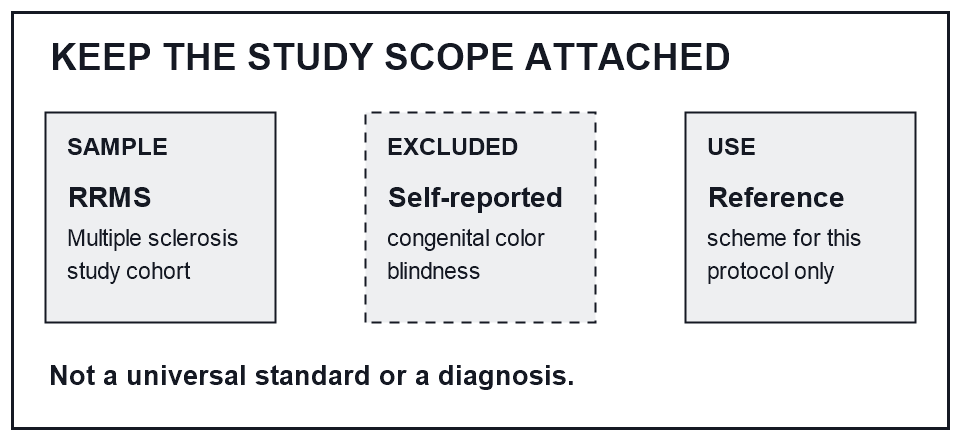
The bands above came from a 2025 study of people with relapsing-remitting multiple sclerosis. The study excluded people who self-reported congenital color blindness. That makes this a reference scheme for that study’s population and protocol—not a general standard for everyone, and not a diagnosis based on a number alone.
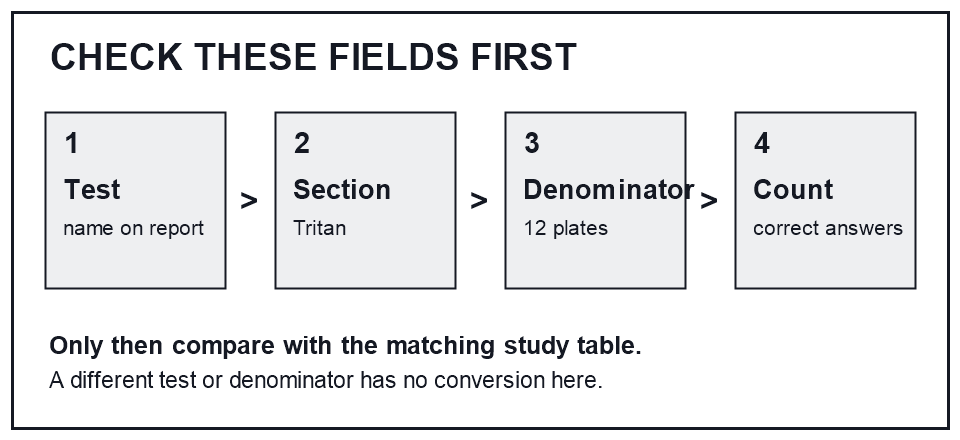
Use the table only when your result identifies the matching 12-plate Tritan section and reports how many answers were correct. A different test, a different section, or a percentage without that same denominator cannot be converted with these rows. A phrase such as “color blind tritanomaly” does not identify the test or section.
“Strong” does not map to “severe” here
The study’s Tritan rows use mild, moderate, and severe. Its protocol provides no score band called “strong.” So a result described as strong elsewhere cannot be relabeled severe from this table; the source gives no crosswalk between those words.
Record the test before reading the label
Copy these fields from the report before comparing anything: test name → section name → number of plates in that section → correct-answer count → label printed by the report. If the report does not identify the test, the Tritan section, and its denominator, stop at the raw result; this study’s bands cannot classify it.
For a question about your own vision, take the report to an eye-care professional. Ask whether its test and scoring system use the same protocol as the table above.