Traffic-signal cues · licensing varies by location
Can Color Blind People Drive? Signals, Rules, and Next Steps
Quick answer
Yes, some color-blind people can qualify to drive; the rule depends on where you live and the license class.
Color vision deficiency is not one nationwide yes-or-no licensing rule. For example, California says a color-blind applicant may qualify for a commercial license if the examining doctor determines they can distinguish red, green, and amber traffic signals, even when those colors look gray. Check the rule for your own state and license class before applying or changing how you drive.
Read California's CDL example Check the federal signal meanings
Why position helps, and where it stops helping
A 2008 archived first-person account by Frank Dutton describes using the usual vertical order of a traffic signal as a cue. It also names two situations where that cue changes: a horizontal signal layout, and a single flashing caution light with no neighboring lamp to show a top, bottom, left, or right position. This is one historical driver's report, not a rule about every color-blind driver's experience.
The practical distinction is simple: position can help only when the signal's layout is known and visible. A lone flashing light has no position cue that identifies its color, so do not infer its meaning from the place where it is mounted.
Three signal layouts, three different cue checks
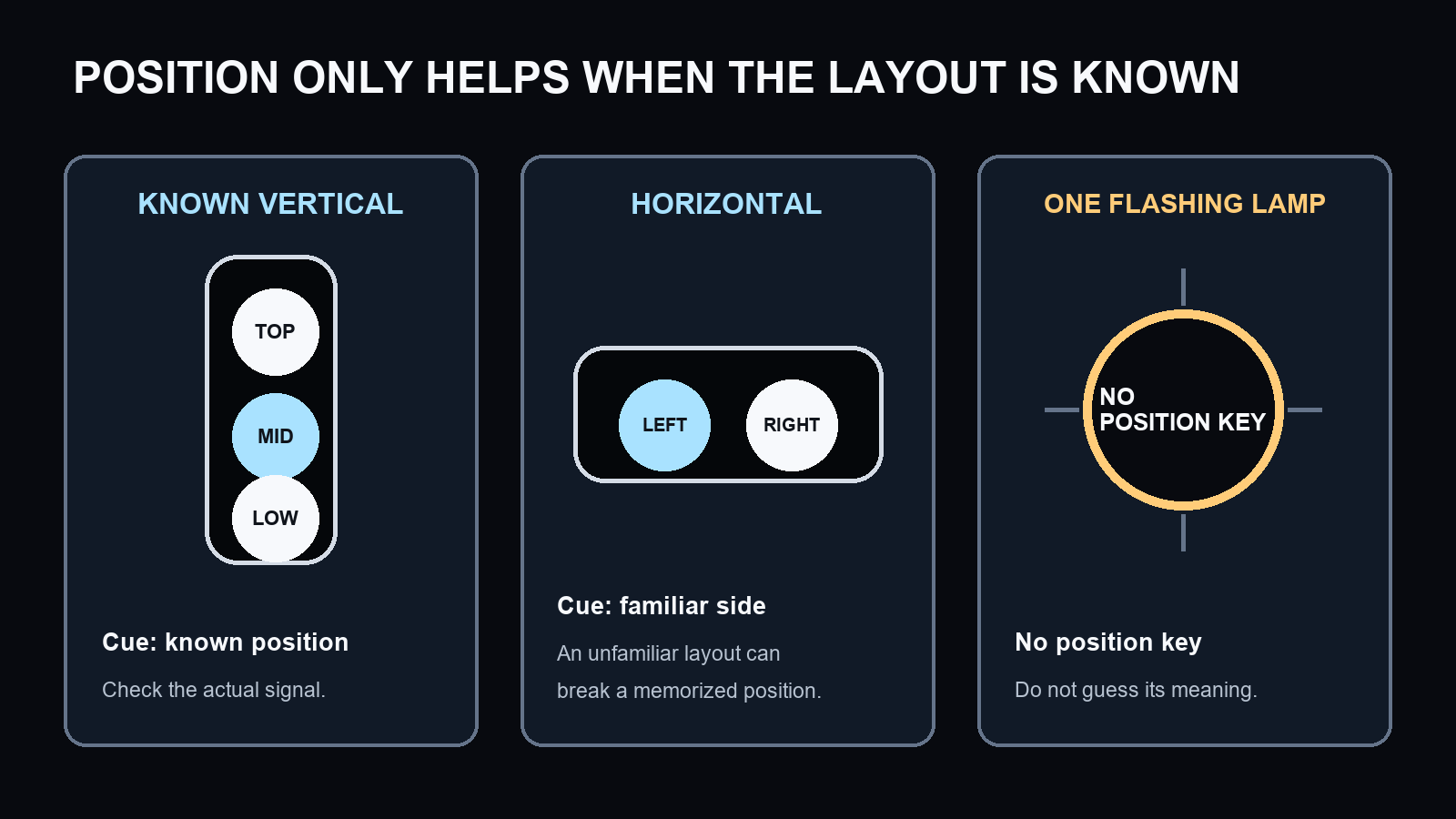
| What is visible? | What the layout tells you | What it cannot tell you |
|---|---|---|
| Known vertical signal | Which lamp position is lit | Whether the local signal follows the layout you expect |
| Unfamiliar horizontal signal | Which side is lit | The color from a remembered vertical order |
| One flashing lamp | That the device is flashing | Red versus yellow from position alone |
This comparison focuses on the cue that changes between layouts. It does not tell a driver to proceed based on a memorized position; read the signal, signs, lane markings, and local driving rules together.
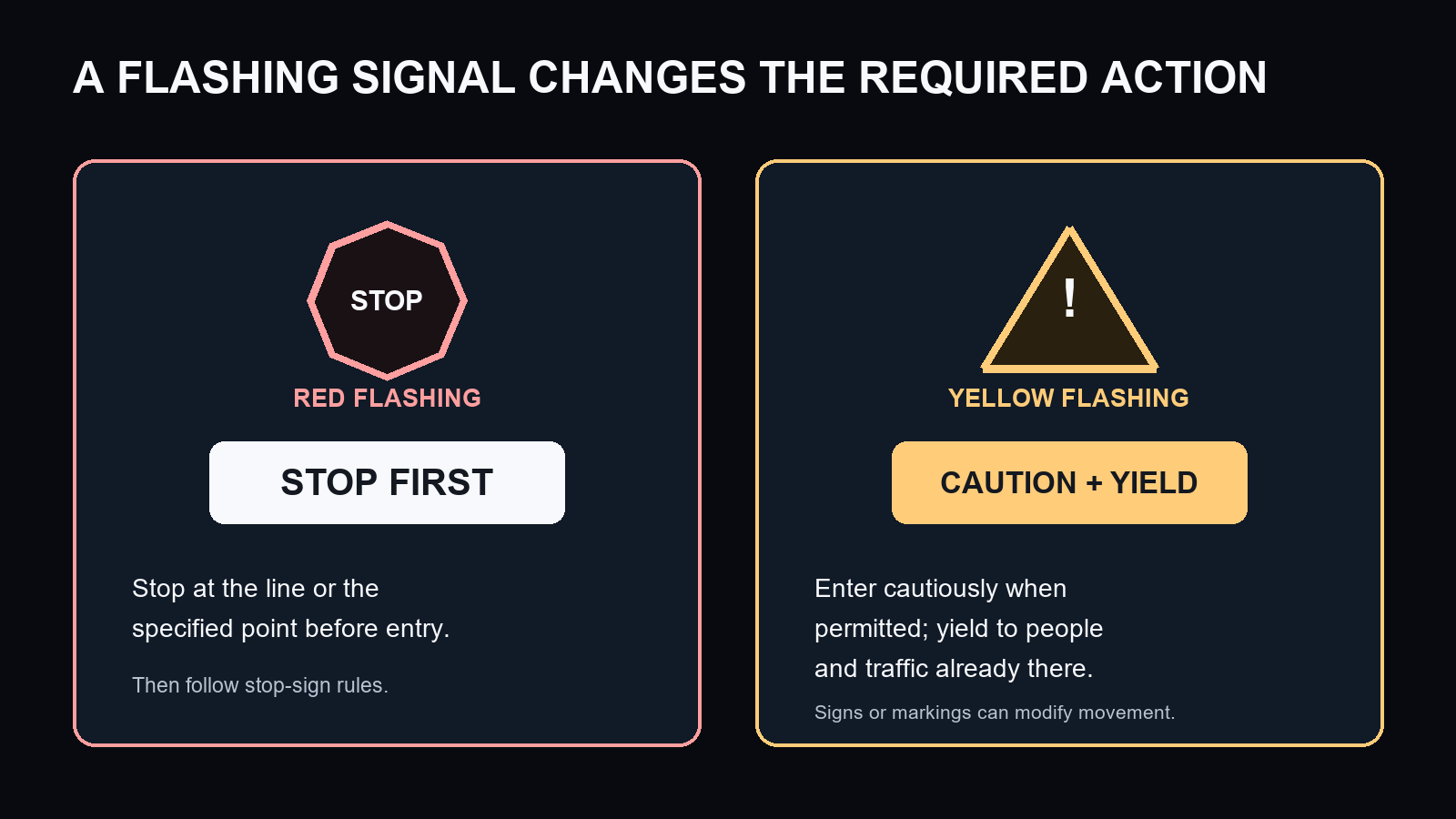
A flashing red and a flashing yellow do not mean the same thing
The current FHWA Manual on Uniform Traffic Control Devices describes different actions for these two indications. Under its intersection rules, a flashing circular red requires a stop at the stop line or the specified point before the intersection; a flashing circular yellow permits cautious entry and requires yielding to pedestrians in the crosswalk and vehicles already in the intersection. Other signs, lane markings, and local rules can change the movement.
If the indication is difficult to identify, do not guess between the two actions. Follow the signs and traffic-control devices you can identify, and check the applicable driver manual before you travel an unfamiliar route.
One driver's report: the isolated blinking light
“The only issues are a single blinking hazard light at an intersection that could be red or yellow.”
That comment is one person's report, not a prevalence estimate or safety study. It shows why the isolated-signal case deserves its own check instead of being hidden inside general advice about traffic-light positions.
A pre-drive signal worksheet
Use this checklist while parked or when reviewing an unfamiliar route. It is a preparation aid, not a substitute for traffic law, a road test, or an eye-care professional.
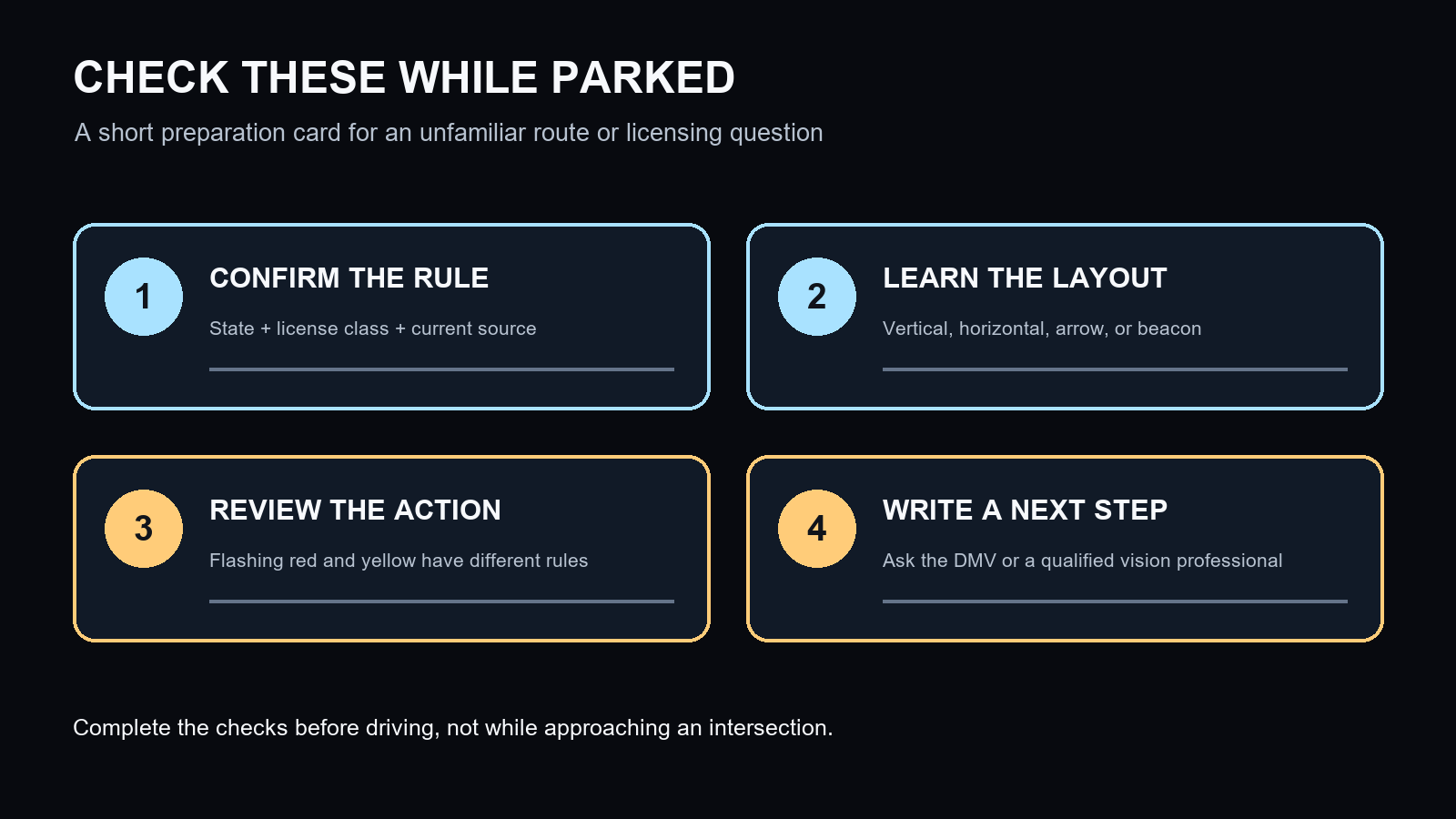
| Check | Write down or verify |
|---|---|
| State and license class | ____________________________ |
| Local driver-manual page for signal rules | ____________________________ |
| Signal layouts on the route | ____________________________ |
| What to do if one cue is unclear | ____________________________ |
| Question for the DMV or vision examiner | ____________________________ |
- Check the current licensing rule for your location and license type.
- Review how local signs and flashing signals work before using a new route.
- If a signal remains unclear, do not choose an action by guessing its color; get guidance from the relevant DMV or a qualified vision professional.
Can colorblind people drive? Check the exact license rule
“Can a colorblind person drive?” and “Can you drive if you are color blind?” do not have one answer that applies to every state and license class. California's commercial-license page is one concrete example: it says a color-blind applicant may qualify when the examining doctor finds that the traffic-signal color standard is met, including when the colors are perceived as shades of gray. That example is not a national rule for every private or commercial license.
Ask the licensing agency which vision standard applies to your application. If you already drive and have trouble identifying a signal, discuss the specific situation with an eye-care professional and the licensing agency rather than relying on glasses marketed for color vision.
What a California CDL color-vision finding changes
California DMV says a color-blind applicant may qualify for interstate or intrastate commercial driving if the examining doctor determines they can distinguish standard red, green, and amber traffic signals, even when those colors appear as shades of gray. If the doctor finds that the color-vision standard is met, DMV says it does not apply the listed passenger, placarded-hazardous-material, or intrastate-only restrictions on that basis. This is a California commercial-license rule, not a blanket rule for private licenses or other states.
Color blind driving at night: what changes?
Nighttime adds glare, surrounding lights, and lower contrast to the signal-layout question. A 2008 archived account describes confusion between nearby lights in poor viewing conditions; a 2026 community commenter separately reported difficulty with red versus yellow at night when the full three-light layout was not visible. These are dated individual reports, not a claim that everyone with color vision deficiency has the same night-driving difficulty.
If you are asking “Can color blind people drive at night?”, ask a qualified vision professional about your own vision and check your local rules. Do not use a simulation or online article as a personal driving assessment.
Source and limits
The exact query “can color blind people drive” was checked in Google’s US natural results on October 1, 2026, in the signed-in Chrome profile; Google displayed Victoria, Texas. The original top ten contained one page whose body could not be read: rank #3, Colorkinds, which showed a Cloudflare security check. It was replaced by the next natural result, rank #11, RSM Optometry. All ten pages in the resulting comparison set—original ranks #1–2 and #4–10, plus #11—were read in full. The comparison and absence claims below refer only to these ten reviewed pages; the unread contents of original rank #3 are unknown.
The archived 2008 account is attributed to its original author and used only for the specific position-cue and flashing-lamp experience. Current flashing-signal actions are drawn from the FHWA MUTCD 11th Edition, Part 4, Section 4A.04. California's DMV page is a state-specific commercial-license example; it does not establish another state's rule. This guide cannot determine an individual's ability or eligibility to drive.