Can You Be a Pilot If You Are Color Blind? Four Country Rules
Sometimes. Color blindness alone does not give a universal yes-or-no answer: the medical decision depends on the aviation authority, certificate class, and its approved color-vision assessment. The FAA, Transport Canada, the UK CAA, and CASA use different test paths and restrictions. A screening result or a simulator view cannot decide an individual application.
Use the comparison below to identify which authority and certificate rule applies to your situation. It is a source map, not a prediction that a particular applicant will qualify.
Start with the authority and certificate, not the label
“Color blind” is not a single aviation test result. A regulator may distinguish between an initial screen, a follow-up assessment, a certificate class, and a restriction. The same person’s path can therefore depend on where the medical certificate is issued and which privileges it covers.
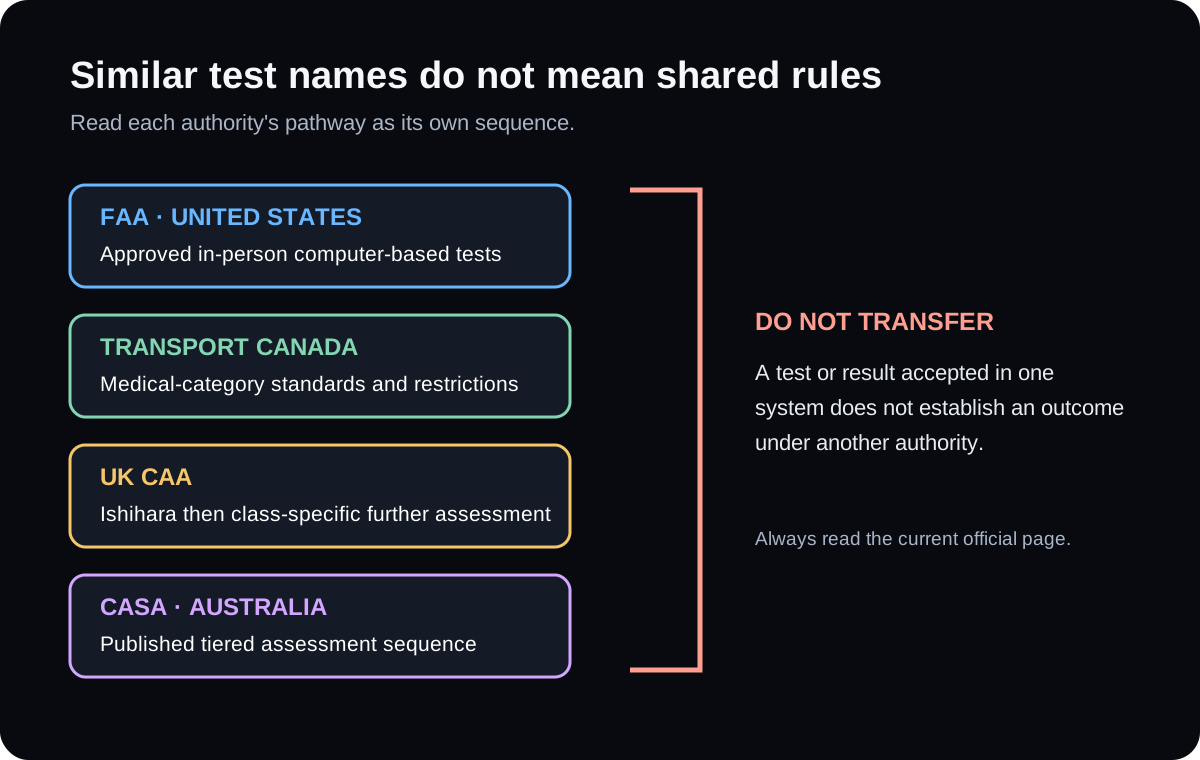
The four systems below are not interchangeable. A test or restriction described by one authority does not establish what another authority will accept.
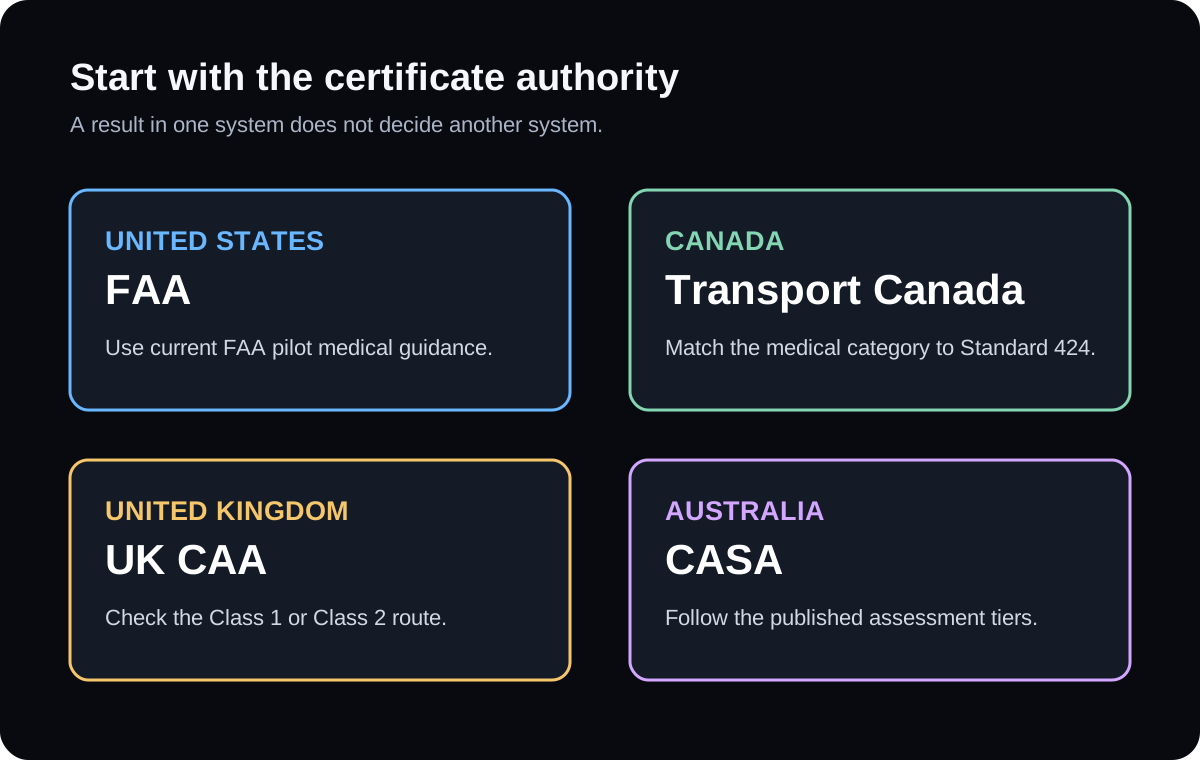
Four official color-vision paths, side by side
| Authority | What its published pathway says | Important boundary |
|---|---|---|
| United States — FAA | For pilot evaluations, FAA guidance effective January 1, 2025 requires an approved computer-based test administered in person. Its guide lists CAD, the Rabin Cone Test (RCCT), and Waggoner computerized tests, with test-specific scoring instructions. | The FAA page covers the listed pilot screening tests. It does not let a reader infer a personal outcome from a diagnosis label or from another country's test. |
| Canada — Transport Canada | Standard 424 separates colour-perception requirements by medical category. The published provisions include plate criteria, alternative tests, and in some categories a possible daylight-only Commercial Pilot Licence restriction with a two-way radio requirement at controlled airports. | Category 1, 2, and 3 criteria differ. Category 2 has its own text and does not use the Category 1 lantern wording. |
| United Kingdom — UK CAA | Initial medical certification starts with Ishihara. For Class 1, a failed screen leads to further assessment; for Class 2, further testing applies and unsatisfactory colour perception can result in a daytime-only limitation. The CAA describes approved alternatives including anomaloscopy and CAD. | The UK CAA says it does not accept lantern testing as evidence of being colour safe. Class 1 and Class 2 rules are not the same. |
| Australia — CASA | For Class 1 and Class 2 pilots, CASA publishes a tiered sequence: Ishihara plates, then FALANT or Optec 900, then CAD or the Australian Operational Colour Vision Assessment (AOCVA). Its page describes possible restrictions after an unsuccessful operational assessment. | CASA has a separate, narrower rule for air traffic controllers. Do not apply that rule to pilot medical certificates. |
Read the current original pages: FAA Guide for Aviation Medical Examiners, Item 52; Transport Canada Standard 424, Appendix II; UK CAA colour-vision guidance; CASA colour-vision assessment for medical certificates.
What “mild” can and cannot tell you
A person’s description of a deficiency as mild, moderate, or severe does not substitute for the named test and scoring rule. The FAA, for example, lists different CAD score criteria for normal, deutan, and protan results, while its Waggoner table names separate sections and denominators. Those are test-specific measurements, not a universal color-vision scale.
Keep these details together when reading a result: the authority, certificate class, test version, tested eye or eyes, score, denominator or units, and any restriction printed on the medical certificate. A general type label cannot supply missing fields.
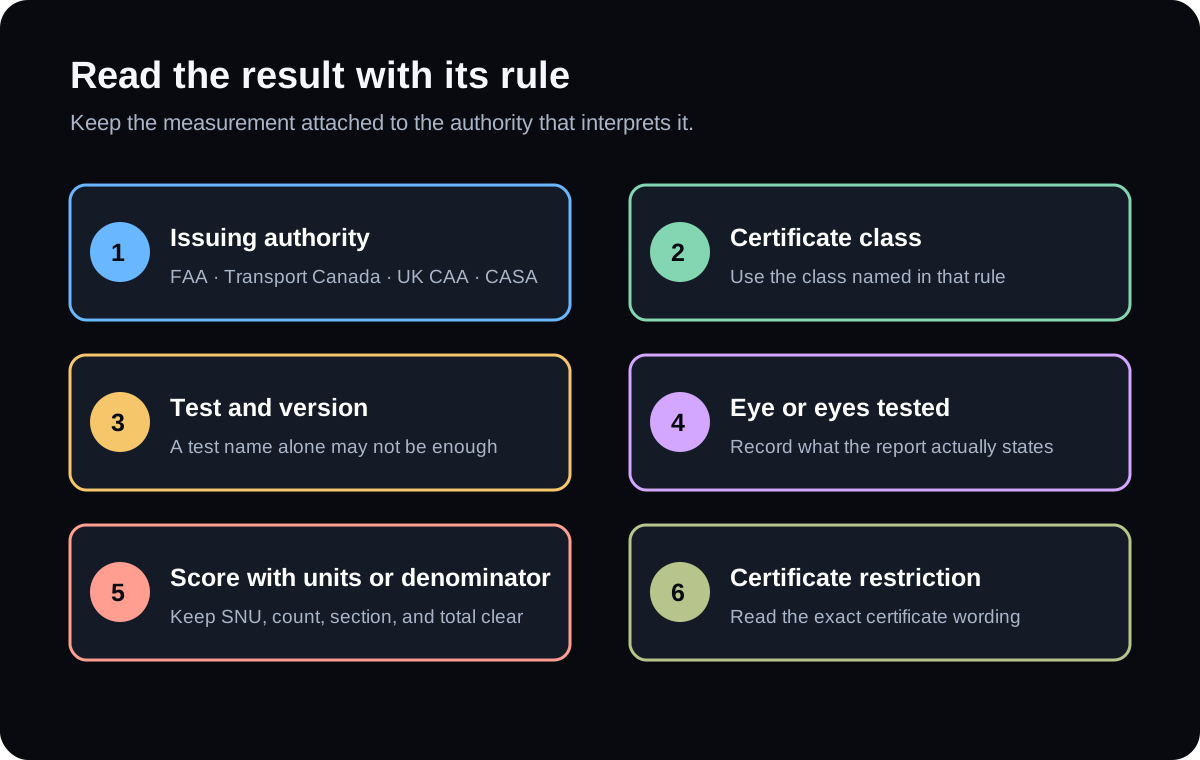
Alternative tests are authority-specific
Names such as Ishihara, CAD, RCCT, Waggoner, Farnsworth D-15, FALANT, and Optec 900 appear in aviation material, but the list is not a menu that every applicant can choose from. The authority's current medical guidance determines which test applies, how it is administered, and what result it means.
Historical terminology can mislead. A 2000 archived page used the phrase “letter of competency” for an FAA-related document. Current FAA material uses the term “Letter of Evidence” in some medical contexts. Similar wording does not prove that old and current documents are identical, and archived descriptions are not current instructions. Archived December 2000 source · Current FAA Guide for Aviation Medical Examiners, version 03/25/2026.
A careful next-step checklist
- Identify the authority that will issue the medical certificate and the certificate class you are asking about.
- Open that authority's current color-vision page and note its first-line test, any follow-up path, and possible restriction language.
- Keep your actual report attached to its test name, version, score format, and testing conditions; do not convert it into another authority's scale.
- Ask the regulator or an authorized aviation medical examiner how the published process applies to your application. This article cannot determine individual fitness.
This checklist identifies the rule to consult. It does not provide tactics for passing, evading, or rehearsing an occupational examination.
Military and other jobs have separate standards
This comparison is about civil pilot medical certification. Searches such as “colorblind military,” “color blindness and the military,” “can you be a military pilot with color blindness,” “can you join the military if you’re color blind,” and “can colorblind people serve in the military” concern separate service and role standards. Electrical work, police work, air traffic control, engineering, and surgery also have their own job-specific requirements. A civil pilot rule does not answer those questions.
For the same reason, the phrases “colorblind electrician,” “can a colorblind person be a police officer,” “color blindness police officer,” “can you be an engineer if you are colorblind,” “can a color blind person be a surgeon,” “can color blind air traffic controller,” “what jobs can colorblind people not do,” “can colorblind people become doctors,” and “can commercial pilots be colorblind” should not be treated as one blanket eligibility question. Air traffic controller medical rules are a distinct category even when the same aviation authority administers them.
Other exact pilot-search wording
“can you be color blind and be a pilot”; “can colorblind people be pilots”; “can i be a pilot if im colorblind”; “can you be a pilot if you re colorblind”; “can a pilot be color blind”; “can you join the military if you re color blind”; and “can you join the military if you are color blind.” The military phrases point to a separate standard; they do not change the civil-pilot comparison.
Frequently asked questions
Can you become a pilot if you are color blind?
It depends on the authority, medical class, and approved assessment. “Can you become a pilot if you are color blind,” “can a colorblind person be a pilot,” “can you be a pilot with color blindness,” “can you be a pilot if you’re colorblind,” “can you be a pilot if you are color blind,” and “can you be a pilot if color blind” are different phrasings of a question that still needs a jurisdiction-specific answer.
Can commercial pilots be colorblind?
Commercial and airline transport medical categories are regulated by the issuing authority. Check the exact category in that authority's official rules; do not assume a private-pilot result transfers to another certificate.
Does the answer change for military pilots?
Military aviation uses service-specific standards, so “colorblind military” and “color blindness and the military” require the relevant service authority. The civil FAA, Transport Canada, UK CAA, and CASA comparison here does not decide military eligibility.
Does a color-vision simulator test pilot eligibility?
No. A simulator previews an image under a color-vision model. It does not measure a person's color vision, reproduce an aviation medical assessment, or determine certificate eligibility.
Sources and scope
- FAA, Guide for Aviation Medical Examiners, Item 52: color-vision testing requirements for pilots; page last updated September 9, 2025. Official page.
- Transport Canada, Canadian Aviation Regulations Standard 424, Appendix II: medical category requirements and restrictions. Official standard.
- UK Civil Aviation Authority, MED.B.075 and colour-vision guidance for Class 1 and Class 2 medical certificates. Official guidance.
- CASA, Colour vision assessment for medical certificates, including the pilot tiers and separate air traffic controller rule. Official page.
- Pilot Medical Solutions, archived “Color Vision” page, captured December 4, 2000. Used only to identify historical wording, not as current FAA policy. Archived source.
- FAA Guide for Aviation Medical Examiners, version dated March 25, 2026. Official PDF.
Rules and guidance can change. The linked regulator is the controlling source for a current application; this page does not diagnose color vision or determine any individual’s fitness or employment eligibility.